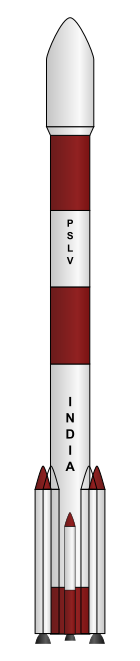
Polar Satellite Launch Vehicle
- Polar Satellite Launch Vehicle
-
Polar Satellite Launch Vehicle
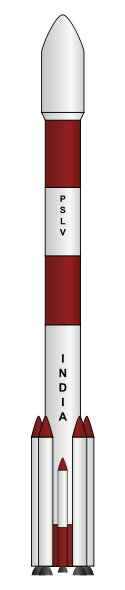
Cohete PSLV |
| Características |
| Funcionalidad |
Lanzadera media |
| Fabricante |
ISRO |
| País de origen |
 India India |
| Medidas |
| Altura |
44 m |
| Diámetro |
2,8 m |
| Masa |
294.000 kg |
| Etapas |
4 |
| Capacidad |
| Carga útil a OTB |
3.250 kg |
| Carga útil a HCO |
1.600 kg[1] |
| Carga útil a OTG |
1.060 kg[1] |
| Cohetes asociados |
| Historia del despegue |
| Estado |
Activo |
| Lugar |
Sriharikota |
| Lanzamientos totales |
16
PSLV: 10
PSLV-CA: 5
PSLV-XL: 1 |
| Con éxito |
14
PSLV: 8
PSLV-CA: 5
PSLV-XL: 1 |
| Fracasos |
1 (PSLV) |
| Fallos parciales |
1 (PSLV) |
| Vuelo inagural |
PSLV: 20 de septiembre de 1993
PSLV-CA: 23 de abril de 2007
PSLV-XL: 22 de octubre de 2008 |
| Cargas destacables |
Chandrayaan-1 |
| Propulsores (Etapa 0) |
| Propulsores |
6 |
| Motores |
1 sólido |
| Fuerza de despegue |
502,6 kN |
| Impulso específico |
262 s |
| Tiempo de combustión |
44 segundos |
| Combustible |
HTPB (sólido) |
| Primera Etapa |
| Motores |
1 sólido |
| Fuerza de despegue |
4.860 kN |
| Impulso específico |
269 s |
| Tiempo de combustión |
105 segundos |
| Combustible |
HTPB (sólido) |
| Segunda etapa |
| Motores |
1 Vikas |
| Fuerza de despuegue |
725 kN |
| Impulso específico |
293 s |
| Tiempo de combustión |
158 segundos |
| Combustible |
N2O4/UDMH |
| Tercera etapa |
| Motores |
1 sólido |
| Fuerza de despuegue |
328 kN |
| Impulso específico |
294 s |
| Tiempo de combustión |
83 segundos |
| Combustible |
sólido |
| Cuarta etapa |
| Motores |
2 líquidos |
| Fuerza de despuegue |
14 kN |
| Impulso específico |
308 s |
| Tiempo de combustión |
425 segundos |
| Combustible |
MMH/UDMH |
Polar Satellite Launch Vehicle ó PSLV es un lanzador orbital indio de tercera generación, propulsado por combustible sólido y desarrollado por ISRO (Indian Space Research Organisation, Organización de Investigación Espacial India) a finales de los años 1980 y principios de los años 1990.
Se han lanzado 12 PSLV, con una tasa de éxito del 91,67%.
Variantes
PSLV
Especificaciones
PSLV C
Especificaciones
- Carga útil: 3.700 kg a LEO (200 km); 1000 kg a una órbita de transferencia geoestacionaria.
- Empuje en despegue: 5.290 kN
- Masa total: 294.000 kg
- Diámetro: 2,8 m
- Longitud total: 44,4 m
Véase también
Referencias
- Wade, Mark (2008). «PSLV» (en inglés). Consultado el 30 de julio de 2008.
Categorías:
- Vehículos de lanzamiento desechables
- Programa espacial de la India
Wikimedia foundation.
2010.
Mira otros diccionarios:
Polar Satellite Launch Vehicle — Données générales Mission Lanceur LEO, GTO, orbite héliosynchrone et orbite polaire Période des lancements De 1993 à aujo … Wikipédia en Français
Polar Satellite Launch Vehicle — Infobox Rocket name = Polar Satellite Launch Vehicle caption = PSLV C8 (CA Variant) carrying the AGILE x ray and γ ray astronomical satellite of the ASI lifting off from Sriharikota function = Expendable launch vehicle manufacturer = ISRO country … Wikipedia
Polar Satellite Launch Vehicle — PSLV Das Polar Satellite Launch Vehicle (Kurz PSLV, Hindi, ध्रुवीय उपग्रह प्रक्षेपण यान) ist eine indische Trägerrakete für leichte bis mittelschwere Nutzlasten. Die Rakete wird von der indischen Raumfahrtbehörde ISRO vom Weltraumbahnhof Satish… … Deutsch Wikipedia
Geosynchronous Satellite Launch Vehicle — GSLV Geosynchronous Satellite Launch Vehicle (GSLV) Características Funcionalidad Sistema de lanzamiento medio Fabricante ISRO País de origen … Wikipedia Español
Advanced Satellite Launch Vehicle — Augmented Satellite Launch Vehicle (ASLV) was the springboard to the advanced Polar Satellite Launch Vehicle (PSLV). The ASLV was not a simple variant of the SLV 3 but a more complex vehicle. The ASLV is actually a 5 stage vehicle since the core… … Wikipedia
launch vehicle — Aerospace. a rocket used to launch a spacecraft or satellite into orbit or a space probe into space. [1955 1960] * * * Rocket system that boosts a spacecraft into Earth orbit or beyond Earth s gravitational pull. A wide variety of launch vehicles … Universalium
Xichang Satellite Launch Center — The Xichang Satellite Launch Center (XSLC) (zh cp|c=西昌卫星发射中心|p=Xīchāng Weìxīng Fāshè Zhōngxīn) also known as Base 27 (二十七基地)Fact|date=June 2008, is a People’s Republic of China space vehicle launch facility (spaceport) approximately 64 km… … Wikipedia
Thor (launch vehicle) — Thor was a space launch vehicle derived from the PGM 17 Thor Intermediate Range Ballistic Missile. The Thor rocket was the first in a large family of space launch vehiclesndash the Delta rockets. Thor s descendants fly to this day as the Delta II … Wikipedia
Nanosatellite Launch System — The Nanosatellite Launch System (NLS) is a series of satellite launch missions coordinated by the Space Flight Laboratory of the University of Toronto Institute for Aerospace Studies. It provides a low cost launch service for nanosatellites.[1]… … Wikipedia
List of launch vehicles — This is a list of space launch vehicles sorted by country/operator in alphabetical order, commercial vehicles are listed under their corresponding country.Americas =Brazil= *Sounding Rockets [ [http://www.aeb.gov.br/conteudo.php?ida=23 idc=124… … Wikipedia